
Industrialized Construction & Decarbonization

Optimizing Permitting for Offsite Construction
June 12, 2026Decarbonizing the Future with Industrialized Construction
British Columbia faces a critical dual challenge: we must rapidly expand our housing supply to accommodate steady population growth while simultaneously making meaningful progress toward our legislated 2030 and 2050 greenhouse gas targets.
While regulatory frameworks like the mandatory BC Energy Step Code and the optional Zero Carbon Step Code have driven major progress in reducing operational emissions, embodied carbon—the emissions locked into material extraction, transport, manufacturing, and construction—remains a massive, largely unregulated footprint. In BC alone, embodied carbon accounts for roughly 4 to 7 MtCO2e annually. As operational energy efficiency improves across new developments, embodied carbon will soon account for nearly 50% of the building sector’s total carbon footprint.
Our latest report explores how Industrialized Construction (IC)—applying manufacturing precision, repeatability, and offsite prefabrication to building delivery—offers an immediate, scalable solution to address both the housing crisis and our climate mandates.
Download the full report here to learn more:
“Industrialized Construction & Decarbonization”
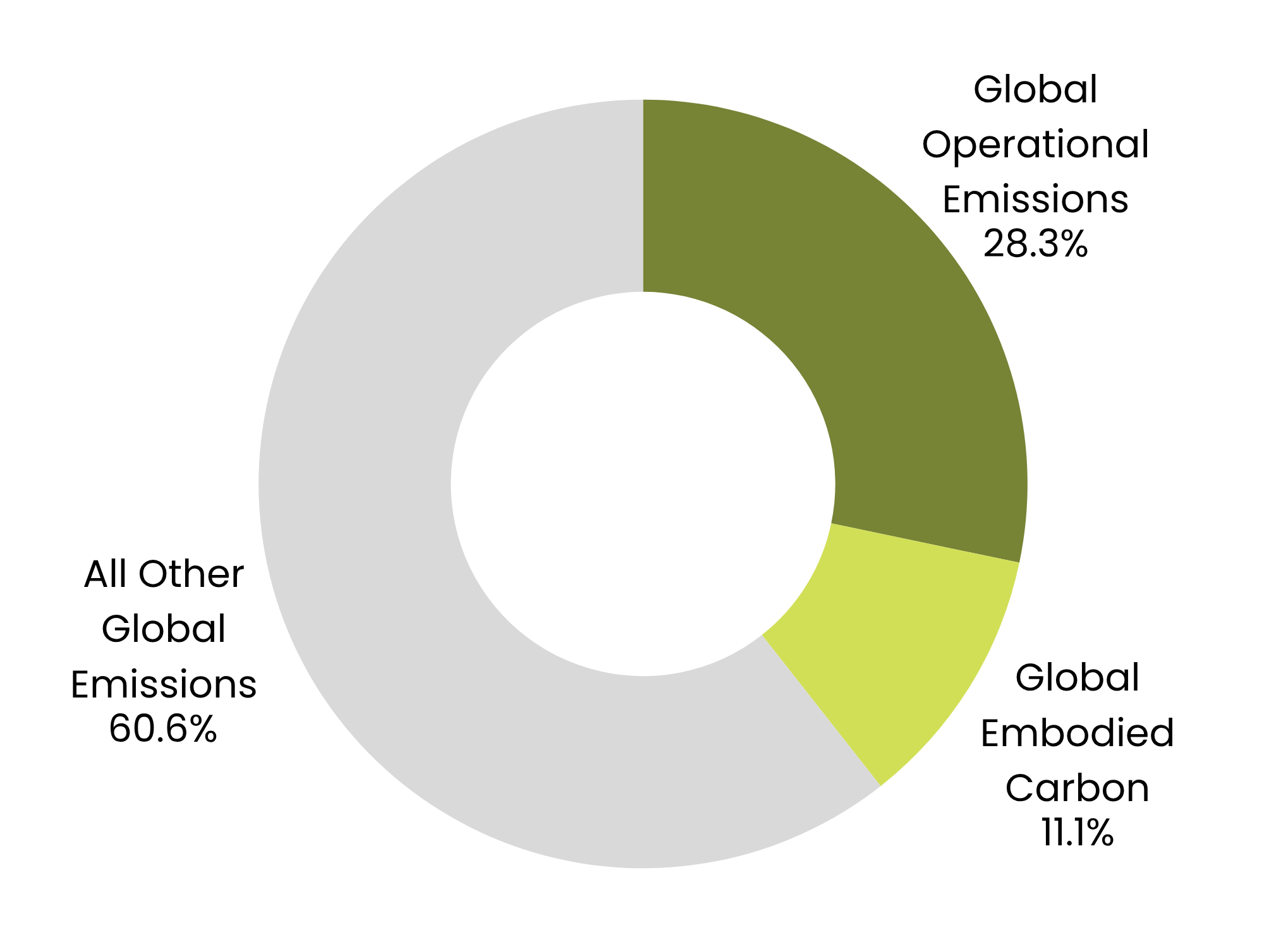
Construction Emissions proportional to Total Global Emissions
Highlights From the Report